
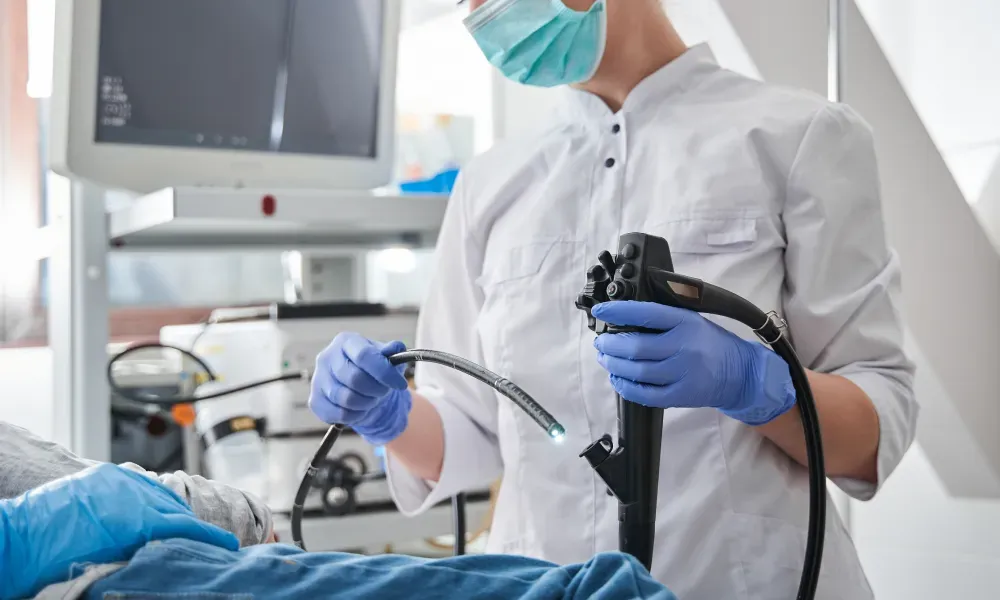
AMT endoscopy is the kind of subject that rewards close attention. Not because it announces itself dramatically, but because the more carefully you examine it, the more you see. The instruments at its centre are narrow, flexible, and extraordinarily capable, entering the body through its natural openings and returning images at a resolution that allows pathology to be identified and treated in a single session. The industry that designs and manufactures these instruments operates under quality standards as precise as the devices themselves.
The Instruments and What They Do
An advanced minimally invasive therapeutic endoscope is, in its physical form, a long flexible tube. That description is accurate but insufficient. Within that tube runs a bundle of light-transmitting fibres or an electrical cable connecting a chip-on-tip camera to an external processor. Adjacent to the optical system run working channels through which instruments pass: biopsy forceps, injection needles, clip applicators, electrosurgical devices. The distal tip articulates in response to controls at the handle. The whole assembly must flex through curves that would fracture anything rigid while maintaining the dimensional integrity of every internal channel.
AMT endoscopic devices are produced to tolerances that most industrial manufacturing never approaches. The working channel must accept instruments of a defined diameter without binding. The articulation cables must transmit force predictably across the full range of tip deflection. The optical system must remain diagnostically useful after the instrument has been bent, cleaned, and reprocessed hundreds of times. Every component is specified, sourced, assembled, and tested within a quality framework that applies at every stage of production.
Quality Standards That Govern the Field
The quality architecture governing advanced therapeutic endoscopy device manufacturing is built on a foundation of international standards, each addressing a specific dimension of the problem.
ISO 13485 is the quality management system standard that applies to medical device production globally. It requires documented process controls, validated manufacturing methods, traceability from raw material to finished device, and a system for managing non-conformances and corrective actions. For AMT endoscopy manufacturers, ISO 13485 certification is the entry condition for participation in regulated supply chains, not a differentiator but a prerequisite.
FDA 21 CFR Part 820 adds requirements for devices distributed in the United States, with particular emphasis on design history files, device master records, and the documented evidence base connecting design intent to production reality. EU MDR conformity, assessed by an independent notified body, applies the most demanding clinical evidence requirements of any major regulatory system, covering not only the device itself but the post-market follow-up programme that continues after it reaches patients.
IEC 60601, the standard governing the electrical safety and electromagnetic compatibility of medical electrical equipment, applies to the imaging processors, light sources, and electrosurgical generators that form the capital equipment component of an AMT endoscopy system. And ISO 11135, the standard for ethylene oxide sterilisation, applies to single-use accessories that must be delivered in a validated sterile state.
Manufacturing and the Supply Chain Behind the Device
The production of AMT endoscopic instruments draws from a supply chain that spans materials science, precision engineering, optical manufacturing, and polymer processing. Single-use accessories including biopsy forceps, injection catheters, and haemostatic clips are typically produced through:
Metal injection moulding
Small, complex metal components in the functional tips of biopsy instruments and clip mechanisms, produced to tight tolerances in stainless steel and cobalt-chrome alloys
Precision polymer extrusion
The thin-walled flexible sheaths and multi-lumen catheter bodies that define the physical form of endoscopic accessories, produced in medical-grade polymers under validated process conditions
Cleanroom assembly
Final assembly of multi-component devices in ISO-classified environments where particulate and microbial contamination are controlled to defined and monitored levels
Validated sterilisation
Ethylene oxide or gamma irradiation cycles validated to achieve sterility assurance levels that satisfy the applicable regulatory standard for the intended use
Singapore has developed a meaningful role within amt endoscopy supply chains, particularly in the production of precision components and single-use accessories. Manufacturers operating there supply device developers and original equipment manufacturers across Asia Pacific, North America, and Europe from facilities certified to ISO 13485 and operating under quality systems aligned with both FDA and EU MDR requirements. Singapore’s combination of advanced manufacturing infrastructure, a technically trained workforce, and a regulatory environment aligned with international standards has made it a reliable source of high-specification endoscopy components for global programmes.
Industry Positioning and the Competitive Landscape
The advanced endoscopy device market is concentrated but not static. The capital equipment segment, comprising reusable imaging platforms and processors, is dominated by a small number of established producers with deep clinical relationships and installed base advantages. The single-use accessory segment is more broadly contested, with specialist producers competing on process capability, quality system maturity, and the ability to supply novel device designs that the established capital equipment producers do not manufacture themselves.
The competitive positioning of any producer rests on the same variables: consistent manufacturing to specification, a quality system that documents that capability, and the regulatory standing to supply the intended markets. These are not soft advantages. They are the infrastructure on which commercial positioning in a regulated industry is built.
A System Worth Understanding
There is something satisfying about examining a system that works. The quality standards, the manufacturing disciplines, the regulatory frameworks, and the clinical demands that together define the advanced therapeutic endoscopy sector are not arbitrary. They were built in response to problems: device failures, patient harm, supply chain breakdowns, regulatory inadequacies. Each requirement has a history visible in the precision of what the system now demands. For anyone working within it or evaluating entry into it, that understanding is the most useful starting point, and the foundation on which everything in amt endoscopy rests.